YTBIO Analyzes How Creatine Monohydrate Supports Sports Nutrition and Supplement Formulation Trends
Oct 24, 2026
Xian, Shaanxi Oct 23, 2026 (Issuewire.com) - YTBIO Analyzes Creatine Monohydrate Trends in Sports Nutrition and Supplement Formulation
As the global sports nutrition market continues to develop, creatine monohydrate remains an important ingredient in products designed for strength training, high-intensity exercise, and general fitness applications. Its established role in energy metabolism, extensive research background, and compatibility with different supplement formats have made it a widely studied ingredient in sports nutrition formulation. Industry developments increasingly focus on ingredient consistency, delivery formats, formulation stability, manufacturing processes, and quality management.
YTBIO is a nutritional supplement manufacturer providing raw materials, finished products, and OEM/ODM manufacturing services. Its creatine monohydrate product range includes powder and gummy formats, reflecting the different formulation and production approaches used in contemporary sports nutrition products. The company's manufacturing processes, product specifications, and quality documentation illustrate several technical considerations associated with creatine-based supplement development.
Creatine Monohydrate Remains a Key Ingredient in Sports Nutrition
Creatine plays an important role in the body's phosphocreatine system, which helps regenerate adenosine triphosphate (ATP), a primary energy source for muscle contractions. During short, intense activities such as resistance training and sprinting, this energy system supports repeated muscular effort.
Creatine monohydrate is widely studied in sports nutrition because of its relationship with high-intensity exercise performance and strength training. Research indicates that supplementation, when combined with appropriate training, can improve performance in repeated high-intensity exercise and contribute to increases in lean body mass over time.
These applications have influenced the development of creatine-based formulations across different product categories. Formulation considerations include ingredient identity, purity, serving size, processing characteristics, and the quality requirements applicable to the intended market. Manufacturers must also account for local regulatory frameworks when developing product specifications and labeling information.
Powder Specifications and Processing Characteristics
Powder remains a widely used format for creatine monohydrate because it can be incorporated into drink mixes, single-serving sachets, and other supplement formulations. Particle size is one factor that manufacturers consider when evaluating raw materials for processing and finished-product consistency.
YTBIO provides 80-mesh and 200-mesh pure creatine monohydrate powder. The product information identifies the ingredient under CAS 6020-87-7 and lists both mesh specifications.
Particle size can influence powder handling, flow properties, dispersion behavior, and processing performance. However, the actual effects depend on the formulation, equipment, processing conditions, and other material characteristics. Selecting a suitable grade therefore requires an assessment of the intended application and the technical requirements of the manufacturing process.
The product information also references inventory availability, sample evaluation, and certifications including ISO 9001, ISO 22000, Kosher, Halal, and HACCP. The validity, scope, and applicability of these credentials should be confirmed against the relevant product and manufacturing facility. Specification sheets, certificates of analysis (COAs), and other quality records can help establish ingredient identity and consistency between production batches.
Single-Serving Powder and Packaging Considerations
Single-serving stick packs represent another format used in sports nutrition products. Compared with bulk powder, pre-portioned packaging provides a defined serving quantity and reduces the need for additional measuring during use.
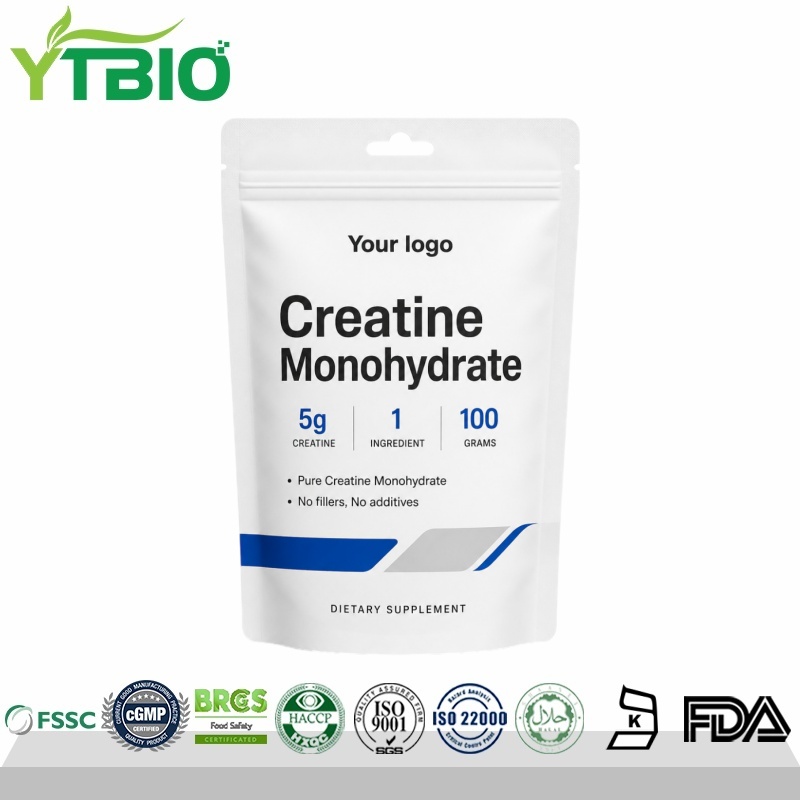
YTBIO lists creatine monohydrate powder in single-serving stick packs. According to the product information, each stick contains 5 grams of creatine monohydrate, with 20 servings in a 100-gram package. The listed formula contains creatine monohydrate without additional ingredients.
From a manufacturing perspective, single-serving products require attention to filling accuracy, packaging integrity, moisture control, and batch consistency. The packaging material must also be compatible with the product's storage conditions and expected shelf life.
YTBIO's product information describes white-label services covering logos, pouch artwork, and label content based on the existing formula. Supporting documentation may include COAs, product specifications, and compliance-related records. The specific documentation required depends on the product category, manufacturing arrangement, and regulations of the destination market.
Creatine Gummies and Alternative Delivery Formats
Gummies represent an alternative supplement format that differs from conventional powders in composition, manufacturing requirements, and physical properties. Unlike powder products, gummies require a suitable base formulation and controlled processing conditions to maintain texture, stability, and consistency.
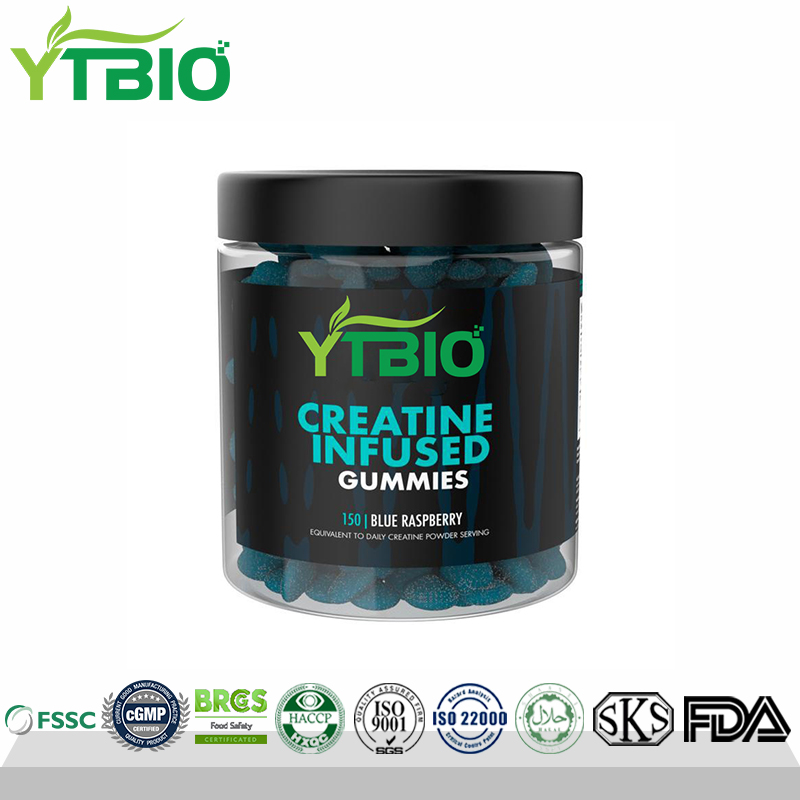
YTBIO lists creatine monohydrate gummies in bottled packaging, with product information describing options for label, ingredient, and packaging customization.
A separate listing covers a creatine gummy product with bulk-order manufacturing support. The published specifications state that each serving consists of three gummies, with 30 servings and 90 gummies per container. Each three-gummy serving provides 3 grams of creatine monohydrate.
The listing also describes a formulation that excludes gluten, soy, yeast, artificial flavors, and artificial colors. Such statements should be supported by appropriate formulation records, ingredient specifications, and allergen-control documentation before being used in finished-product labeling.
Gummy production involves several technical considerations, including ingredient compatibility, moisture content, texture, taste, packaging materials, and shelf-life validation. The interaction between creatine and other formulation components must also be assessed under the intended processing and storage conditions. These factors distinguish gummy manufacturing from conventional powder production and require format-specific quality controls.
OEM and ODM Manufacturing Processes
OEM and ODM services are part of the wider manufacturing structure for dietary supplements. These arrangements can involve existing formulations, customized ingredient combinations, packaging development, labeling, and production coordination.
YTBIO's company information describes manufacturing services covering powders, gummies, capsules, softgels, and tablets. The company also identifies custom formulation support, ready-made product formats, packaging, labeling, and production coordination among its service areas.
Manufacturing across multiple dosage forms requires different equipment, production controls, and testing procedures. Powder products may require controls for particle distribution, flow properties, and filling accuracy, while gummies require additional monitoring of texture, moisture, and physical stability. Capsules and tablets have their own requirements for weight variation, disintegration, and other applicable quality parameters.
YTBIO also describes processes related to ingredient traceability, laboratory verification, batch consistency, and quality management. Its stated after-sales procedures include responses to label-compliance questions within 24 hours and traceability information for ingredient- and efficacy-related feedback within 72 hours. These service descriptions illustrate the role of documentation and communication in managing technical questions throughout the supplement manufacturing process.
For international manufacturing arrangements, the responsibilities of the ingredient supplier, finished-product manufacturer, brand owner, and distributor should be clearly defined. Documentation requirements and product-release procedures vary according to the regulatory framework and the responsibilities assigned to each party.
Quality Control and Regulatory Compliance
Quality assurance remains a central consideration in sports nutrition manufacturing. Relevant controls may include raw material identification, purity testing, contaminant screening, production monitoring, finished-product testing, packaging verification, and stability assessment.
YTBIO identifies cGMP, FSSC 22000, ISO 22000, and ISO 9001 among its company-level certifications and quality systems. The scope of each credential should be reviewed to establish whether it applies to a particular facility, process, or product category. Product-specific records are also important because company-level certification does not independently establish the quality specifications of every finished product.
Labeling and product communication require similar attention. Statements concerning exercise performance, strength, recovery, or muscle development should be supported by appropriate scientific evidence and comply with applicable advertising and labeling regulations. Product composition, serving quantities, allergen information, and storage instructions should accurately reflect the finished formulation.
Quality documentation also supports traceability when manufacturing deviations, consumer feedback, or product-quality questions arise. Consistent records can help identify the relevant production batch, assess the scope of an issue, and determine appropriate corrective actions.
Conclusion
Creatine monohydrate remains an established ingredient in sports nutrition research and formulation. Its use across conventional powders, single-serving stick packs, and gummy formats demonstrates how a common active ingredient can be incorporated into products with different manufacturing and packaging requirements.
YTBIO's product range includes 80-mesh and 200-mesh creatine monohydrate powder, pure powder stick packs, and creatine gummies. Its described OEM/ODM services, traceability procedures, product documentation, and quality management systems provide examples of the operational considerations involved in producing creatine-based supplements.
Across the industry, ingredient specifications, processing conditions, dosage-form requirements, quality verification, and regulatory compliance remain central to the development and manufacture of sports nutrition products.
Further information about YTBIO's products and manufacturing operations is available at https://www.ytbio-healthy.com/
Media Contact
Shaanxi Yuantai Biological Technology Co., Ltd.
+86 17782577059
Source :Shaanxi Yuantai Biological Technology Co., Ltd.
This article was originally published by IssueWire. Read the original article here.










YOUR NEWS, OUR NETWORK.
Do you have Great News you want to tell the world?
Be it updates about your business or your community, you can make sure that it’s heard by submitting your story to our network reaching hundreds of news sites across 6 verticals.